
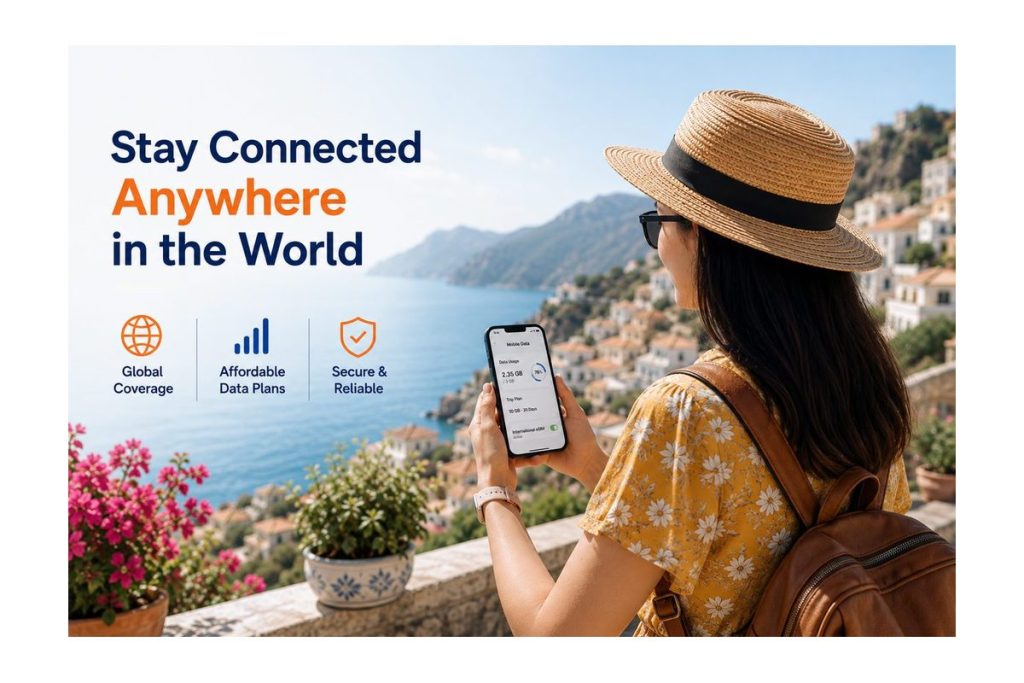
Introduction
Traveling abroad should be exciting, but staying connected can become expensive and complicated.
International roaming can lead to high data charges, while buying a local SIM often means finding a store, comparing plans, and changing your existing SIM.
Today, travelers have another option: eSIM.
With an eSIM, you can purchase a travel data plan online and stay connected abroad without relying on expensive roaming.
Why Avoid International Roaming?
Roaming allows you to use your existing mobile number while traveling, but it can come with extra costs.
Common problems include:
- Unexpected data charges
- Expensive daily roaming fees
- Limited data allowances
- Complicated roaming packages
- Difficulty tracking actual usage
For longer trips or frequent travelers, these costs can quickly add up.
Roaming vs Local SIM vs eSIM
There are three common ways to stay connected abroad.
1. International Roaming
Best for: Travelers who need to keep everything exactly as it is.
Your existing SIM connects to a partner network in another country.
Pros:
- Keep your existing number
- No SIM installation required
- Easy to use
Cons:
- Can be expensive
- Data charges may be higher
- Roaming packages can be confusing
2. Local SIM
Best for: Travelers staying longer in one country.
You purchase a physical SIM after arriving and use a local network.
Pros:
- Local network access
- Local calling options
- Can be useful for long stays
Cons:
- Requires a physical SIM
- You may need to visit a store
- SIM swapping can be inconvenient
- Your original SIM may need to be removed
3. eSIM
Best for: Travelers who want convenient data access without physical SIM swapping.
You purchase a plan online and install it digitally on your compatible smartphone.
Pros:
- Buy before your trip
- No physical SIM required
- Quick setup
- Easy to manage
- Useful for multi-country travel
Cons:
- Requires an eSIM-compatible device
- Usually focused on data rather than a local phone number
- Setup requires internet access
Which Option Is More Convenient?
For short international trips, convenience can make a big difference.
| Feature | Roaming | Local SIM | eSIM |
| Setup | Very easy | Requires store visit | Digital setup |
| Physical SIM | No | Yes | No |
| Cost Control | Can vary | Usually prepaid | Usually prepaid |
| Buy Before Travel | Sometimes | No | Yes |
| Multi-Country Use | Depends on plan | Limited | Often available |
| Keep Primary SIM | Yes | Usually no | Yes |
For travelers who mainly need mobile data, eSIM offers a convenient balance between flexibility and cost control.
How to Stay Connected Without Roaming Charges
If you want to avoid unexpected roaming costs, follow these simple steps:
1. Choose an eSIM Before Your Trip
Select a plan based on your destination, travel duration, and expected data usage.
2. Install the eSIM Before Departure
Set up the eSIM while you still have reliable Wi-Fi.
3. Use the eSIM for Mobile Data
Once you arrive, select the travel eSIM as your mobile data line.
4. Control Your Primary SIM
Keep your regular SIM available when needed, but check your phone settings to prevent unwanted roaming data charges.
When Is a Local SIM Still Better?
An eSIM isn’t always the right choice for everyone.
A local SIM may make more sense if:
- Your phone doesn’t support eSIM
- You need a local phone number
- You’re staying in one country for a long period
- You prefer purchasing directly from a local carrier
The best option depends on your travel needs.
How Much Can You Save by Avoiding Roaming?
The actual cost depends on your mobile carrier, destination, and plan.
Instead of automatically using roaming, compare the total cost of:
- Your carrier’s roaming package
- A local SIM
- A travel eSIM
For travelers who mainly need data for maps, messaging, browsing, and travel apps, a prepaid eSIM can provide more predictable spending.
Why Simigo is a Practical Choice
Simigo provides travel eSIM plans designed for people who want to stay connected without depending on traditional roaming.
With online purchase, digital activation, and prepaid options, travelers can prepare their connectivity before leaving home.
This means less time dealing with SIM stores and more control over your travel data.
Tips to Avoid Unexpected Roaming Charges
Before leaving for your trip:
- Check your carrier’s roaming settings
- Turn off data roaming on your primary SIM if you don’t need it
- Select your travel eSIM for mobile data
- Check your eSIM data allowance
- Use Wi-Fi when convenient
- Monitor your data usage
These simple steps can help prevent unwanted charges.
Conclusion
Staying connected abroad doesn’t have to mean paying expensive roaming charges.
Roaming, local SIMs, and eSIMs each have their advantages, but the right choice depends on your destination, trip length, phone compatibility, and data needs.
For travelers looking for a simple, flexible, and prepaid way to stay online, eSIM is a practical alternative to traditional roaming.
With the right travel plan, you can focus on your journey without worrying about unexpected connectivity costs.
Frequently Asked Questions (FAQ)
1. Can I use an eSIM instead of international roaming?
Yes. A travel eSIM can provide mobile data abroad without requiring you to use your carrier’s international roaming service.
2. Is eSIM cheaper than roaming?
It can be, depending on the destination, carrier, and plan. Comparing prices before your trip is the best way to determine the better value.
3. Can I keep my regular SIM while using an eSIM?
Yes, many compatible smartphones support both a physical SIM and an eSIM.
4. Should I turn off roaming when using an eSIM?
If you want to avoid accidental roaming charges, check your phone settings and make sure your primary SIM isn’t being used for mobile data.
5. Is a local SIM better than an eSIM?
It depends on your needs. A local SIM can be useful for long stays or local calling, while an eSIM is generally more convenient for travelers who mainly need data.